New Research Explores How Asbestos May Slowly Turn Healthy Cells into Mesothelioma
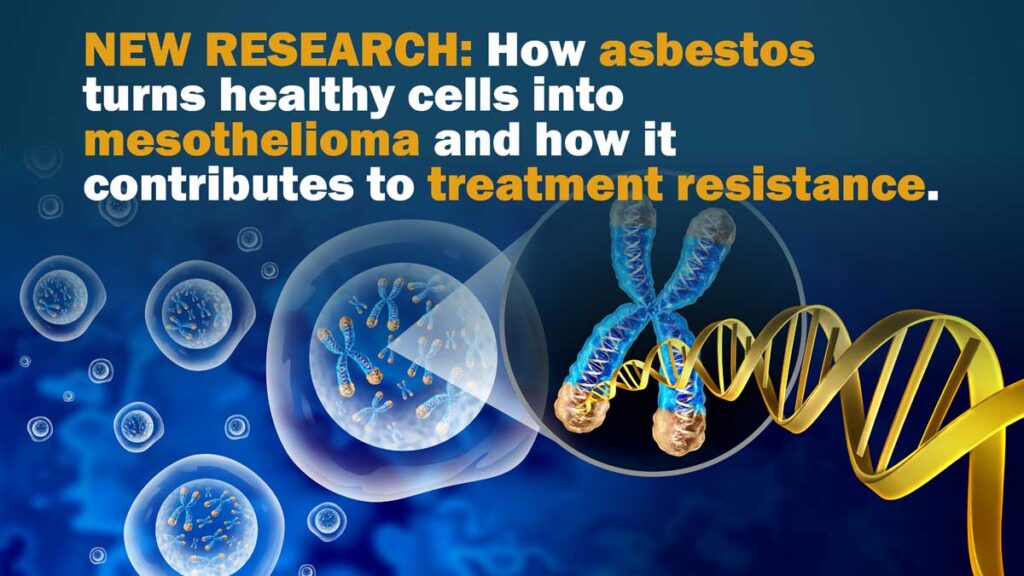
For decades, scientists have known that mesothelioma, an extremely aggressive cancer of the lining of the lungs or other organs, is caused by asbestos exposure. What has remained less clear is exactly how asbestos changes healthy cells over time and why the disease often develops decades after exposure.
A newly published study by Dr. Taylor Ripley and colleagues at Baylor College of Medicine offers an important new clue. Their research suggests that asbestos may gradually push healthy cells toward cancer by damaging them just enough to cause genetic instability, but not enough to kill them.
The findings may help researchers better understand how mesothelioma develops and could eventually point toward new treatment strategies.
The Challenge of Understanding Mesothelioma
Table of Contents
Mesothelioma develops after tiny asbestos fibers are inhaled or ingested and become trapped in the body. Over many years, those fibers can trigger inflammation, oxidative stress, and cellular damage.
One of the most unique aspects of mesothelioma is its long latency period. Many patients are diagnosed 20 to 50 years after their exposure occurred. Researchers have long wondered why it takes so long for the disease to develop.
This new study explores the process by which asbestos slowly reshapes healthy mesothelial cells, the cells that make up the pleura around the lungs, in ways that eventually promote cancer growth.
Study Structure
The researchers conducting this study exposed healthy human mesothelial cells to two common forms of asbestos fibers, chrysotile and crocidolite, over a six-month period in the laboratory.
Rather than exposing the cells to massive doses that would immediately kill them, the scientists used lower levels designed to mimic long-term chronic exposure.
Over time, the researchers observed that the asbestos-exposed cells began behaving differently from normal cells.
Specifically, the cells became more mobile, more invasive, better able to survive stressful conditions, and more capable of forming colonies, all traits commonly associated with cancer cells.
But importantly, the cells were not fully cancerous yet. Instead, they developed what the researchers described as “malignant-like” behavior, meaning they were starting to resemble cancer cells.
A Key Discovery: “Minority MOMP”
One of the most important findings involved a process inside cells known as apoptosis, or stated plainly, cell death.
Apoptosis is the body’s built-in system for removing damaged cells. When cells become severely injured, they are usually programmed to self-destruct so they cannot pass along mutations.
Mitochondria, often called the “power plants” of the cell, play a major role in this process.
Normally, when a cell is badly damaged, the mitochondria send signals that activate cell death. Scientists call this process MOMP, short for mitochondrial outer membrane permeabilization.
But in this study, the researchers found evidence of something different: a partial or incomplete version called “minority MOMP,” or mMOMP.
With mMOMP, only some mitochondria inside the cell release distress signals. The damage is enough to injure the cell’s DNA, but not enough to fully trigger cell death.
In simpler terms, the cell survives when it probably should not.
That survival may be dangerous because damaged cells can continue dividing and accumulating and amplifying mutations over time.
The researchers believe this process may help explain how asbestos exposure slowly contributes to mesothelioma development over many years.
One of the most important aspects of cancer prevention inside the body is the ability to eliminate damaged cells before they become dangerous.
This study suggests asbestos may interfere with that protective process.
The asbestos-exposed cells showed the following features:
- Increased DNA damage
- Increased oxidative stress
- Signs of mitochondrial dysfunction
- Activation of cancer-related pathways
Yet the cells avoided dying.
Researchers identified a protein called MCL-1 as a possible reason why.
MCL-1 helps cells resist apoptosis. The study found that asbestos-exposed cells had increased levels of this protein, which may help damaged cells stay alive even after serious injury.
This finding is especially important because MCL-1 is already being studied as a possible therapeutic target in mesothelioma and other cancers.
Connections to Treatment Resistance
The study also uncovered another concerning feature.
The asbestos-exposed cells began showing characteristics similar to what scientists call “drug-tolerant persister cells.”
These are cells that can temporarily survive chemotherapy or other cancer treatments. They are believed to play a role in treatment resistance and cancer recurrence.
The asbestos-exposed cells grew more slowly, adapted to stress, and showed resistance to cisplatin, a chemotherapy drug commonly used to treat mesothelioma.
This does not mean asbestos exposure automatically creates treatment-resistant cancer. However, the findings suggest that some of the biological changes linked to treatment resistance may begin very early in the cancer development process.
Future Implications of this Knowledge
This research does not immediately change how mesothelioma is diagnosed or treated because the study was performed in laboratory-grown cells, not in patients.
Still, the findings are important because they provide a clearer picture of how asbestos exposure may gradually transform healthy cells over time.
Researchers hope that understanding these early mechanisms could eventually lead to:
- Better prevention strategies
- Earlier detection methods
- New drug targets
- Treatments aimed at restoring normal cell death pathways
The study also reinforces an important message long recognized by the medical community: there is no safe level of asbestos exposure.
Even low-level exposure over long periods may trigger biological changes that increase cancer risk.
As scientists continue studying the molecular pathways involved in mesothelioma, discoveries like this one may help pave the way toward more effective therapies in the future.

Related Posts


A study into the experience of caregivers yields first findings
January 13, 2026

$83 Million Verdict on Behalf of Mesothelioma Client against American Art Clay Company (AMACO)
September 23, 2025