Advances and Controversies in Mesothelioma Treatment: Insights from Dr. Jeffrey Velotta
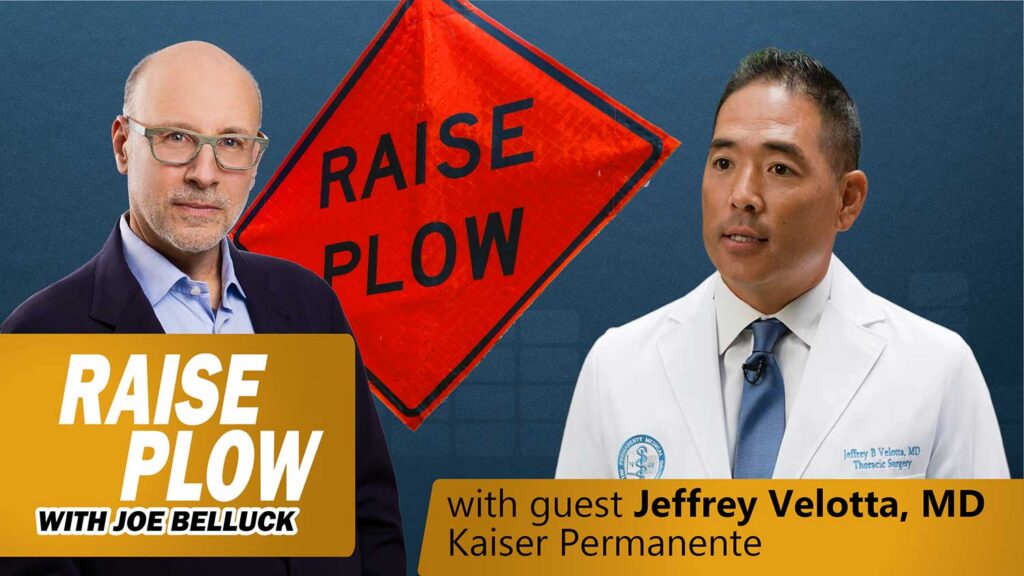
Mesothelioma remains one of the rarest and most complex cancers to treat, demanding highly specialized expertise and a coordinated, multidisciplinary approach. In a recent episode of Raise Plow, the podcast by Belluck Law, thoracic surgeon Dr. Jeffrey Velotta shared an in-depth look at how modern mesothelioma care is evolving, from surgical techniques to systemic therapies and ongoing debates within the medical community.
Watch the full episode here:
Table of Contents
A Specialized Approach to a Rare Disease
Dr. Velotta serves as a thoracic surgeon at Kaiser Permanente, where he leads the mesothelioma surgical program in Northern California. Working alongside medical oncologist Dr. Jennifer Suga, he helps oversee a multidisciplinary tumor board that reviews cases across the broader Kaiser network.
Because mesothelioma is so rare, centralized expertise is critical. As Dr. Velotta explained, “Mesothelioma is super rare, anywhere from two thousand to three thousand cases in a year.”
That rarity creates a major challenge: many physicians may encounter the disease only once or twice in their careers, if at all. This scarcity of experience has real consequences.
“If you’re only seeing it once or twice a year, how can you consider yourself knowing exactly how to do this type of surgery?” he said. In contrast, high-volume specialists who regularly treat mesothelioma are better equipped to manage its complexity and risks.
Training at the World’s Leading Centers
Dr. Velotta’s expertise was shaped by training at some of the most respected institutions in thoracic oncology, including Brigham and Women’s Hospital under the legendary Dr. David Sugarbaker. At the time, the Brigham was performing roughly 200 mesothelioma surgeries annually, making it one of the busiest centers in the world.
“That was the ‘mecca,’” Dr. Velotta recalled, where surgeons handled “five to six of these a week” and saw “dozens of patients” in clinic. This volume allowed him to master both traditional and evolving surgical techniques.
The Shift Toward Lung-Sparing Surgery
Historically, the dominant surgical procedure for mesothelioma was the extrapleural pneumonectomy (EPP), which involves removing the affected lung along with surrounding tissue. While effective in removing disease, it carries significant risks.
Today, the preferred approach has shifted toward pleurectomy and decortication (P/D), a lung-sparing surgery that removes the cancerous lining while preserving the lung.
“The main difference is that [with EPP] you remove the entire lung,” Dr. Velotta explained. “The newer procedure, the pleurectomy decortication, is taking off the lining but saving the lung.”
This evolution reflects better outcomes for patients. “If you save the lung, your morbidity, your mortality, everything is way lower,” he said. “You’re going to have a better recovery.”
In fact, Dr. Velotta noted that he has not needed to perform an EPP in several years, underscoring how dramatically practice has changed.
Why Expertise Matters
Mesothelioma surgery is among the most technically demanding procedures in medicine. Unlike many modern operations that can be performed minimally invasively, mesothelioma surgery still requires large open incisions.
“It is one of the last surgeries that we do that is classically still open,” Dr. Velotta said. Surgeons must remove tumor from critical structures like “the aorta, the esophagus, the heart and the lung itself.”
Because of this complexity, outcomes vary significantly depending on where patients receive care. “You want somebody that does a lot of these,” he emphasized. Without specialized teams, patients may face higher complication rates and poorer outcomes.
The MARS-2 Trial Controversy
One of the most contentious issues in mesothelioma care today stems from the MARS-2 Trial, a randomized study that compared chemotherapy alone to chemotherapy plus surgery.
The trial concluded that adding surgery did not improve survival and might even worsen outcomes. However, Dr. Velotta and many U.S. surgeons have expressed concerns with this interpretation.
“They looked at all comers,” he said, including patients with advanced disease who are typically not surgical candidates. Additionally, the study reported unusually high surgical mortality rates, with “nine percent of patients [dying] within ninety days.”
In experienced centers, he noted, mortality should be “under two to three percent.”
Because of these limitations, many specialists believe the study does not reflect real-world outcomes at high-volume centers. Still, its influence has been significant, leading some programs to scale back or eliminate surgery altogether.
The Power of Multimodal Treatment
Rather than relying on surgery alone, Dr. Velotta emphasizes a comprehensive, multimodal strategy that combines multiple therapies.
“We never say that surgery alone is going to cure you,” he explained. “We always recommend surgery in a multimodal fashion.”
This typically includes:
- Surgery to remove visible tumor
- Chemotherapy to target remaining cancer cells
- Immunotherapy to boost the body’s immune response
Patients who complete this sequence often see the best outcomes. “Those patients… are going to live longer,” he said.
Chemotherapy remains a cornerstone of treatment, often using combinations like cisplatin or carboplatin with pemetrexed. Immunotherapy, a newer option, has shown promise, particularly in more aggressive disease subtypes.
Emerging Techniques and Innovations
In addition to standard treatments, Dr. Velotta is exploring newer intraoperative techniques, including the use of heated betadine.
“Betadine actually kills mesothelioma cells,” he said, describing its tumoricidal effects. Unlike heated chemotherapy, which can increase complications, this approach appears to have fewer side effects while still offering potential benefits.
Although long-term data is still being collected, innovations like this highlight the ongoing effort to refine and improve treatment.
The Importance of Integrated Care
One advantage of large systems like Kaiser Permanente is the ability to coordinate care seamlessly across specialties.
“All of your doctors, hospitals, nurses [and] care is all within our system,” Dr. Velotta explained. This integration helps ensure continuity, reduces logistical burdens, and improves communication among providers.
For patients facing a complex and aggressive disease, this level of coordination can make a meaningful difference.
Financial and Emotional Realities
Beyond medical treatment, mesothelioma carries a significant financial and emotional toll. The disease is linked to asbestos exposure, making legal compensation an important consideration for many families.
“It’s a no-brainer to me,” Dr. Velotta said. “There’s a cause and effect with asbestos causing mesothelioma.”
Given the disease’s aggressive nature, he emphasized the importance of planning ahead. “The majority will be gone within a couple years,” he said, noting that treatment costs, travel, and caregiving can create substantial burdens.
Seeking compensation, he added, can help protect families during an incredibly difficult time.
A Critical Moment in Mesothelioma Care
As research evolves and debates continue, mesothelioma treatment is at a crossroads. While some centers are moving away from surgery studies like MARS-2, others continue to advocate for specialized, multimodal care.
For patients, the takeaway is clear: expertise matters. Consulting with experienced specialists and receiving individualized treatment plans can significantly impact outcomes.
“This is the one cancer where you need to find those people,” Dr. Velotta said. “Because if you don’t, you’ll often get a wrong answer.”

Related Posts

What the Newly Published 2026 NCCN Guidelines Mean for Mesothelioma Patients
September 11, 2026