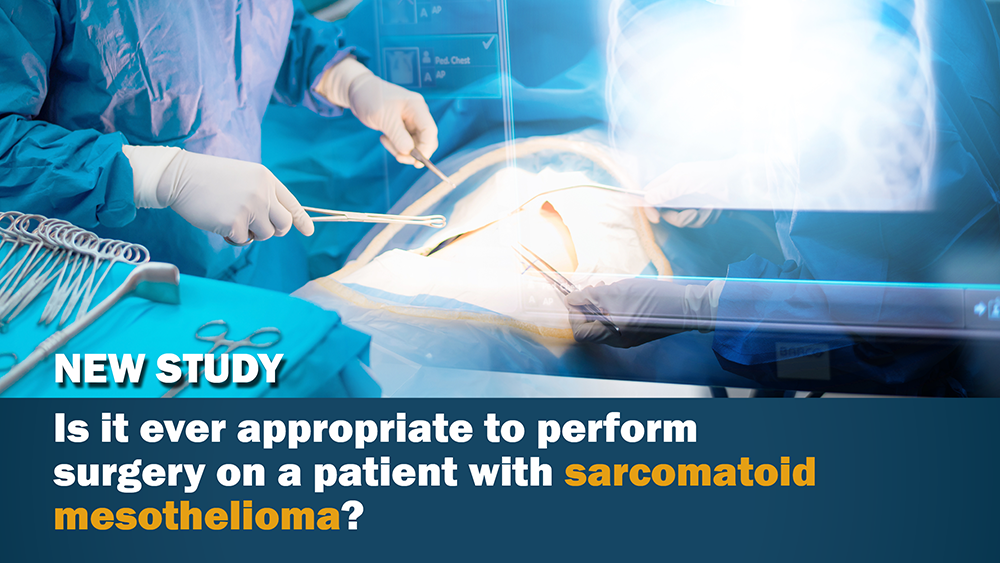
Is it ever appropriate to perform surgery on a patient with sarcomatoid mesothelioma?
Usually, the answer is almost always no.
Sarcomatoid mesothelioma is one of the rarest and most aggressive cell types of mesothelioma, a cancer that develops on the lining of the lungs and stems from exposure to asbestos. Because of its severity and limited treatment options, doctors and researchers have long debated whether surgery has a meaningful role in treating it.
But a recent study by the mesothelioma team at Harvard suggests that, yes, there could be instances when sarcomatoid mesothelioma should be operated on.
The study, Lapidot M, Mazzola E, Bueno R. Feasibility of multimodality treatment, including pleurectomy decortication, in carefully selected patients with sarcomatoid mesothelioma. Transl Lung Cancer Res 2026;15(1):11. doi: 10.21037/tlcr-2025-990 examines patients treated at a specialized cancer center to offer new insight into this question. The findings suggest that while surgery is not beneficial for most patients with sarcomatoid mesothelioma, a carefully selected group may experience improved survival when surgery is combined with other treatments.
Understanding sarcomatoid mesothelioma
Table of Contents
Mesotheliomas are typically subdivided into three distinct groups based on the predominant type of cell that makes up the tumor. Pleural mesothelioma itself is an uncommon cancer, and sarcomatoid mesothelioma represents the least common subtype and the most aggressive. Sarcomatoid mesothelioma has traditionally not responded to chemotherapy, and for this reason surgery for sarcomatoid mesothelioma was mostly seen as futile due to the historically short patient survival of less than a year. (In recent years, with the advent of immunotherapy, sarcomatoid mesothelioma has seen drastically improved survival, however this study was conducted before immunotherapy FDA approvals).
About the study
- This study was conducted prior to immunotherapy becoming standard of treatment for mesothelioma
- The study followed 34 patients
- The study consisted of a pleurectomy decortication (PD) operation
The outlook for people diagnosed with mesothelioma is often limited. Across all types of pleural mesothelioma, the median survival time is about eight months, meaning that half of patients live longer than that and half not as long.
Sarcomatoid mesothelioma tends to behave differently from other forms of the disease. It often spreads more aggressively through the chest and nearby tissues. Because of these characteristics, many clinical guidelines have historically discouraged surgery for patients with this subtype unless it is part of a research study.
The Question: Can Surgery Help?
The study focused on a surgical procedure called pleurectomy decortication, often abbreviated as PD. This operation involves removing the diseased lining of the lung and any visible tumor tissue while preserving the lung itself. In some cases, surgeons may also remove portions of nearby structures such as the diaphragm or the membrane surrounding the heart if the cancer has spread to those areas.
The procedure is typically used as part of a “multimodality” treatment plan. That means surgery is combined with other treatments such as chemotherapy. In some patients in the study, doctors also delivered heated chemotherapy directly into the chest cavity during surgery to target any remaining cancer cells.
Researchers wanted to determine whether this aggressive treatment approach could help people with sarcomatoid mesothelioma live longer.
How the Study Was Conducted
The researchers reviewed medical records from patients treated at a large academic cancer program between 2007 and 2019. Over that 13-year period, 34 people with sarcomatoid mesothelioma underwent pleurectomy decortication at the center.
Most of the patients in the study were men, and the average age was about 71 years old. Nearly three-quarters had a known history of asbestos exposure, which is known to be the primary cause of mesothelioma.
Before surgery, each patient underwent extensive testing. This included imaging scans, heart and lung function testing, and biopsies to confirm the diagnosis. A multidisciplinary team of specialists reviewed every case to determine whether surgery was appropriate.
The goal of the operation was to remove all visible tumor tissue, a result known as “macroscopic complete resection.” However, this is often difficult to achieve in sarcomatoid mesothelioma because the cancer frequently spreads widely within the chest.
What the Researchers Found
Overall, the results showed that surgery provided limited benefit for most patients with sarcomatoid mesothelioma.
Across all 34 patients in the study, the median survival after surgery was about 7.4 months.
However, some important patterns emerged when the researchers looked more closely at the data.
- First, surgeons were able to remove all visible tumor tissue in about two-thirds of the patients. Those individuals tended to live somewhat longer than patients whose tumors could not be fully removed, although the difference was not large enough to be considered statistically significant in this relatively small study.
- Second, patients who received additional treatment after surgery, such as chemotherapy, showed better survival compared with those who did not.
- The most striking finding involved lung function. Researchers measured lung capacity using a test called forced expiratory volume in one second, or FEV1. Patients whose lung function was at least 80 percent of the expected level for their age and size had a median survival of about 20 months.
This was dramatically longer than the survival seen in the overall group of patients.
Why Lung Function Matters
Good lung function may indicate that a patient is healthier overall and better able to tolerate major surgery and other treatments. Patients with stronger lungs may also recover more quickly after the operation and have a better chance of receiving additional therapy.
The findings suggest that lung function could play an important role in determining which patients are most likely to benefit from surgery.
Risks and Challenges of Surgery
Pleurectomy decortication is a major surgical procedure, and the study highlighted the risks involved.
In the group of patients analyzed, about 3 percent died within 30 days of surgery, and nearly 15 percent died within 90 days.
The average hospital stay was almost two weeks.
These risks help explain why surgery is typically reserved for carefully selected patients and for those treated at experienced medical centers.
What the Findings Mean
The study reinforces the idea that sarcomatoid mesothelioma remains extremely difficult to treat. For many patients, surgery alone does not significantly extend survival.
However, the research also suggests that the story may be more nuanced than previously believed.
A small subset of patients with early-stage disease and strong lung function may benefit from a combination of treatments that includes surgery. For these individuals, survival may be considerably longer than what is typically expected for this aggressive cancer.
Looking Ahead
The authors of the study emphasized that their findings should be interpreted cautiously. The research involved a relatively small number of patients from a single medical center, and additional studies are needed to confirm the results.
Future clinical trials may provide more answers, particularly as new treatments such as immunotherapy are incorporated into multimodality treatment strategies.
Researchers are continuing to explore whether combining surgery with modern therapies could improve outcomes for patients with sarcomatoid mesothelioma.
A Careful Balance
For patients and doctors facing this diagnosis, the decision to pursue surgery is complex. The potential benefits must be weighed against the risks and the overall health of the patient.
This study adds valuable information to that discussion. It suggests that while surgery is not the right choice for most patients with sarcomatoid mesothelioma, it may offer meaningful benefit to a select group when performed as part of a coordinated treatment plan at experienced centers.
As research continues, doctors hope to refine how patients are selected for different treatments, ultimately improving survival and quality of life for those affected by this challenging disease.