Asbestos Exposure Aboard the USS Ammen (DD-527)
You may be entitled to receive compensation. Mesothelioma and lung cancer victims & their families have been awarded over $1 million+ from easy access to funds. Call us today to apply.
Over the past 30 years, we've helped 1,000s of families claim the compensation they deserve with no upfront costs to them.
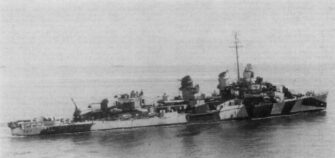
The USS Ammen (DD-527) was a Fletcher-class destroyer laid down at the Bethlehem Shipbuilding Corporation in San Francisco on November 29, 1941, launched on September 17, 1942, and commissioned on March 12, 1943. She was known to her crew as the “Flaming Ammen.” Her main engines produced 60,000 shaft horsepower through Westinghouse turbines driving two screws, and she could make 35 knots. Fast, agile, and heavily armed, she was the kind of warship the Fletcher class was built to be, and she served with extraordinary distinction across nearly two decades of American naval history.
Ammen earned eight battle stars during World War II. She escorted convoys through Alaskan waters, fought in the Pacific Theater across New Guinea, the Philippines, and Okinawa, and was present at some of the defining naval engagements of the war. On November 1, 1944, a twin-engine bomber crashed into Ammen, resulting in 26 casualties, including five dead, a testament to the dangers her crew faced in combat. After the war she was briefly decommissioned, then recalled to service when history demanded it again. With the commencement of the Korean War, the Navy took steps to increase its fleet, recommissioning Ammen in 1950. After a brief training session in Cuba, she was released to the Atlantic Fleet. In 1952, she left for European waters in the Mediterranean, and then departed for the Far East.
On 19 July 1960, while making the transit between Seal Beach and San Diego for decommissioning, Ammen was struck by Collett (DD-730). The collision killed 11 Ammen sailors and injured 20 others. She was decommissioned on 15 September 1960, and sold for scrapping on 20 April 1961.
It was a final chapter marked by tragedy that echoed the violence of her wartime years. But for many of the men who served aboard the Flaming Ammen across her seventeen years of active life, the greatest danger they faced was not a Japanese aircraft or a collision in the harbor. It was the asbestos that had been built into every compartment, every pipe run, and every machinery space of the ship they called home.
Built With Asbestos, From Keel to Superstructure
Table of Contents
The USS Ammen was laid down and commissioned at a time when asbestos was ubiquitous in naval shipbuilding. The U.S. Navy, acutely aware of the fire risk aboard warships carrying fuel, ammunition, and aviation gasoline, mandated the use of asbestos throughout its vessels as a fireproofing and insulation material. The result was that every ship commissioned during the 1940s, 1950s, and 1960s was saturated with asbestos from while still in the shipyard.
The U.S. Navy used asbestos on every class of ship built between the 1930s and early 1980s. Over 1,000 U.S. Navy and Coast Guard ships built before 1983 contained asbestos. The USS Ammen, as a Fletcher-class destroyer built at the height of wartime naval construction, was no exception.
Prior to the mid-1970s, asbestos was a common material used in shipbuilding, and could be found in equipment such as boilers, turbines, pumps, valves, and electrical components. Additionally, materials including gaskets and packing were often made entirely from asbestos. On a destroyer like the Ammen, these materials were present in extraordinary quantities relative to the ship’s size, packed into the engine rooms, boiler spaces, and machinery compartments that occupied much of the vessel’s interior.
Products containing asbestos were not only found in below-deck areas. Pipe insulation, adhesives, electrical cables, deck coverings, laundry and galley equipment, and valves also contained the dangerous mineral. A sailor aboard the USS Ammen could not walk from bow to stern without passing through spaces lined, wrapped, and packed with asbestos. The ship’s very structure was a source of continuous, inescapable exposure.
The Spaces Below Deck Where Asbestos Exposure Was Most Intense
Among the most dangerous spaces aboard the Ammen were those that her engineering crew like the machinist’s mates, boiler tenders, and other ratings who kept the ship moving called their workplace. The engine and boiler spaces held an especially high concentration of asbestos.
The Ammen’s propulsion plant, which consisted of Westinghouse turbines generating 60,000 shaft horsepower to drive two screws, operated at extreme temperatures that demanded insulation throughout. Every surface of the boilers was covered in asbestos-containing block insulation. The steam lines that carried high-pressure steam from the boilers to the turbines were wrapped in asbestos pipe covering. The valves and pumps that controlled the flow of steam and seawater throughout the engineering plant were packed with asbestos gaskets and packing material that had to be regularly replaced.
When equipment like pipes and boilers were installed or repaired, they released clouds of asbestos. Because of the close quarters and poor ventilation on Navy ships, service members could easily breathe in or swallow asbestos fibers. In the confined spaces of a destroyer’s engineering compartments which were already hot, loud, and physically demanding to begin with, there was nowhere for those clouds of fiber to go. They concentrated in the air that the engineering crew breathed, hour after hour, watch after watch, deployment after deployment.
A 2019 International Journal of Radiation Biology study of more than 114,000 U.S. Navy veterans found significantly elevated mesothelioma mortality rates among engineering and machinery rates. Machinist’s mates, boiler technicians, pipefitters, fire control technicians and water tenders had the highest mesothelioma death rates in the study, confirming that the heaviest exposure occurred in engineering spaces below deck.
A Ship’s Entire Crew at Risk
The danger aboard the USS Ammen was not limited to those who worked in the engineering spaces. Every sailor who lived and worked aboard the ship, regardless of their rating or duty station, was exposed to asbestos in the course of daily shipboard life.
Anyone who worked on or near Navy ships from the 1930s to the early 1980s could have been exposed to asbestos, the only known cause of mesothelioma cancer. Because of the close quarters and poor ventilation on Navy ships, service members could easily breathe in or swallow asbestos fibers.
A gunner’s mate who never set foot in the engine room still slept in a berthing compartment insulated with asbestos. A cook who spent his days in the galley worked in a space where laundry equipment and galley fittings contained asbestos. A signalman on the bridge was surrounded by asbestos-containing materials in the ship’s superstructure. And during the routine maintenance that was the constant backdrop of shipboard life, when gaskets were replaced, pipe covering was removed and reinstalled, and insulation was cut to fit new fittings, asbestos fiber entered the air of compartments throughout the ship.
Beyond those who served aboard the Ammen herself, the danger extended to the shipyard workers who built her at Bethlehem Steel in San Francisco, and to those who maintained and repaired her at shipyards across her seventeen years of service. Shipyard workers who crawled through the ship’s compartments to perform overhauls, cutting through insulation, replacing gaskets, working in poorly ventilated spaces, accumulated some of the heaviest asbestos exposures.
The companies that provided the Navy with these asbestos products were aware how hazardous asbestos could be, but did nothing to warn those serving aboard the USS Ammen or its contemporaries. As a result, few if any sailors took proper precautions while working with asbestos, and many developed mesothelioma and other asbestos-related illnesses as a direct result.
The Collett Collision and Its Aftermath
The final chapter of the USS Ammen’s service life added one more layer of tragedy to a ship that had already seen extraordinary loss. While en route to San Diego for decommissioning, Ammen collided with Collett (DD-730), killing 11 of Ammen’s crew. The collision that ended the ship’s active life also forced a major emergency response aboard a vessel that was thoroughly saturated with asbestos-containing materials, a response that may have exposed rescue workers, damage control crews, and shipyard personnel to additional concentrations of asbestos released by the structural damage.
The subsequent scrapping of the vessel in 1961 represented perhaps the most concentrated single point of asbestos exposure in the ship’s entire history. Breaking apart a ship that has accumulated nearly two decades of asbestos-containing insulation, gaskets, packing, tile, and construction materials releases enormous quantities of fiber, a hazard that the workers of the National Metal and Steel Corporation who dismantled the Ammen faced without the benefit of modern protective equipment or any regulatory oversight.
The Disease That Follows Veterans Home
The asbestos that filled the spaces of the USS Ammen did not stay aboard when her sailors went ashore. Fibers clung to their uniforms, their hair, and their skin, riding home with them on liberty and on discharge, thus exposing their loved ones as well.
Because of this, family members may have faced a second layer of risk. Spouses who washed work clothing and children who hugged returning service members may have been exposed through this household contact.
Mesothelioma’s Long Latency
Mesothelioma, the aggressive and incurable cancer of the tissue lining surrounding the lungs, abdomen, or heart, is caused by asbestos exposure, and one of its defining characteristic is the extraordinary length of time between first exposure and first diagnosis which can take anywhere between 10 to 60 years. A sailor who served aboard the Ammen in the 1950s and left the Navy in 1960 may have lived a full civilian life, raising a family, building a career, growing old, before the first symptoms appeared decades later.
Navy veterans are at a high risk of developing mesothelioma because of the amount of asbestos the United States Navy used. The men who served aboard the USS Ammen, who endured combat in two wars, who survived kamikaze attacks and a devastating midship collision, and who gave years of their lives to their country, now face a medical threat long after their service ended.
VA Benefits and Legal Compensation for Mesothelioma: Understanding Your Options
Veterans who develop mesothelioma or other asbestos-related illnesses as a result of their service aboard ships like the USS Ammen have two distinct avenues for seeking support: VA benefits and legal compensation through civil litigation against the manufacturers of the asbestos-containing products used aboard the ship.
Belluck Law works to get veterans compensation from the companies that manufactured and sold asbestos products to the Navy for use on board ships. This process does not impact VA benefits. The manufacturers of the boiler insulation, valve packing, gasket compounds, pipe covering, and other asbestos-containing products installed aboard the USS Ammen knew the hazards their products posed and chose not to warn the sailors who would spend years in their presence. Those companies bear significant legal accountability, separate from the Navy’s own institutional responsibilities.
An experienced asbestos attorney who specializes in Navy veteran claims can review your service record, identify the specific manufacturers whose products were aboard the USS Ammen during your tour of duty, and pursue compensation through personal injury litigation or asbestos trust fund claims, at no upfront cost to you or your family.
Statutes of limitations apply to asbestos claims, and the window to file can close. For a disease that has already been waiting, in many cases, for half a century to reveal itself, time is always the most critical factor.