Roadmap for Treating Pleural Mesothelioma: New Expert Consensus

A new expert consensus document by top mesothelioma experts on behalf of The Society of Thoracic Surgeons (STS), published in The Annals of Thoracic Surgery in 2026, provides the most up-to-date treatment recommendations based on a comprehensive review of the medical literature. Pleural mesothelioma is a rare and aggressive cancer that forms in the thin lining surrounding the lungs. It has long been associated with asbestos exposure and carries a poor prognosis. For decades, doctors have debated the best way to treat it, particularly whether surgery should play a central role.
The document was developed by an international panel of specialists, including thoracic surgeons, medical oncologists, radiation oncologists, and pathologists, all with deep experience treating this disease. The group (view members below) reviewed 116 studies and used a structured voting process to reach agreement on 13 key questions about how to diagnose, evaluate, and treat pleural mesothelioma.
Authors and their affiliations: (1) Jeffrey Velotta, MD, Kaiser Permanente (surgeon); (2) Anja Roden, MD, Mayo Clinic (pathologist); (3) Jonathan Rice, MD, PhD, University of Arizona (surgeon), (4) Charles Simone, MD, New York Proton Center, Memorial Sloan Kettering Cancer Center (radiation oncologist); (5) Bansari Upadhyay, The Society of Thoracic Surgeons; (6) Pallavi Sood, The Society of Thoracic Surgeons; (7) Daniel Miller, MD, Medical College of Georgia (surgeon), (8) Taylor Ripley, MD, Baylor College of Medicine (surgeon); (9) Andrea Wolf, MD, Mount Sinai (surgeon); (10) Bryan Burt, MD, University of California Los Angeles (surgeon); (11) Samuel Kim, MD, Northwestern University (surgeon); (12) Isabelle Opitz, MD, University of Zurich (surgeon); (13) Hedy Kindler, MD, University of Chicago (medical oncologist); (14) Harvey Pass, MD, New York University (surgeon); (15) JW Awori Hayanga, MD, West Virginia University (surgeon); (16) Valerie Rusch, MD, Memorial Sloan Kettering Cancer Center (surgeon); (17) Raphael Bueno, MD, Harvard Medical School (surgeon).
Getting the Diagnosis Right
Table of Contents
One of the panel’s strongest recommendations is that an accurate diagnosis requires a surgical biopsy of the pleural tissue, not just fluid analysis. While doctors can sometimes detect mesothelioma from fluid drained from around the lung, this method catches only 30% to 75% of cases and generally only identifies one of the three subtypes of the disease. The three subtypes (epithelioid, biphasic, and sarcomatoid) behave very differently, and knowing which one a patient has is critical for choosing the right treatment. The panel recommends taking multiple biopsy samples from different locations because mesothelioma cells often differ from one area to another.
When performing a biopsy, surgeons should use the fewest number of incisions, ideally just one, and should make it as small as possible. Its placement should be located where a future surgical incision would go. This minimizes the risk of tumor cells seeding into new areas.
Thorough Staging Is Essential
Before any treatment decisions are made, patients should undergo a PET/CT scan, which combines metabolic and anatomic imaging to reveal whether the cancer has spread. Studies show PET/CT changes the treatment plan in up to 40% of patients by revealing disease that standard CT scans miss. The panel also recommends invasive staging procedures, such as mediastinoscopy or endobronchial ultrasound, when imaging suggests the cancer may have reached nearby lymph nodes. In some cases, a laparoscopy (a minimally invasive look into the abdomen) can detect cancer spread that imaging fails to pick up, found in roughly 17% of surgical candidates in one study.
A Team Approach to Treatment
The panel strongly recommends that every mesothelioma patient’s case be reviewed by a multidisciplinary tumor board, a team that includes thoracic surgeons, oncologists, radiation specialists, radiologists, and pathologists. Because the disease is so rare and complex, treatment decisions should not be made by any single specialist in isolation. If a local hospital lacks mesothelioma expertise, patients should be referred to a high-volume center where surgeons regularly perform these operations.
Surgery: Still on the Table, but with Important Caveats
The role of surgery in mesothelioma has been hotly debated, particularly after a 2024 randomized trial called MARS2 found that patients who had surgery after chemotherapy did not live longer than those treated with chemotherapy alone and experienced reduced quality of life. However, the expert panel notes that MARS2 had limitations, including incomplete preoperative staging and a 9% postoperative death rate at 90 days, which is higher than what specialized centers typically report.
The panel concludes that surgery can still benefit carefully selected patients when performed at experienced centers as part of a multimodal plan (combining surgery with chemotherapy and/or radiation). The best surgical candidates tend to have the epithelioid subtype, disease that has not spread to distant lymph nodes, good overall fitness, and adequate heart and lung function.
When surgery is performed, the panel strongly favors lung-sparing procedures called pleurectomy/decortication (P/D) or extended pleurectomy/decortication (EPD) over extrapleural pneumonectomy (EPP), which removes the entire lung along with the diseased lining. Data from the STS national database confirm this shift: 86% of mesothelioma surgeries performed between 2015 and 2025 were P/D procedures, with only 14% being EPP. The lung-sparing approach carries lower operative mortality (4% or less) and achieves similar or better survival.
The goal of any surgery should be macroscopic complete resection, meaning removal of all visible and palpable tumor. Partial removal, or “debulking,” is not recommended.
Chemotherapy, Radiation, and Emerging Options
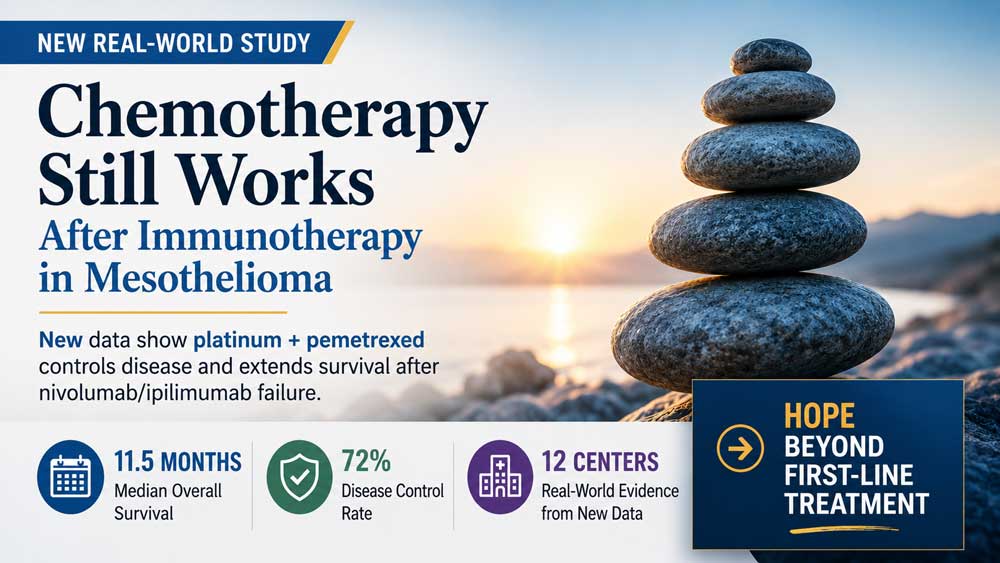
Systemic chemotherapy, typically platinum-based drugs combined with pemetrexed, remains a core part of treatment. Whether it is given before or after surgery should be individualized. Radiation therapy also plays a role, particularly for managing recurrences. Stereotactic body radiation therapy has shown excellent results for isolated recurrences, with local control rates above 96% at one year and minimal side effects. Immunotherapy with drugs like nivolumab is also emerging as a promising option in the perioperative setting.
The Bottom Line
Pleural mesothelioma remains a difficult disease with limited survival, but this consensus document makes clear that outcomes improve when patients receive accurate diagnoses, thorough staging, and individualized multimodal treatment at specialized centers. Surgery is not for everyone, but for the right patient treated by the right team, it remains a meaningful part of the fight against this cancer.
Sources
Velotta JB, Roden AC, Rice J, Simone CB, Upadhyay B, Sood P, Miller DL, Ripley RT, Wolf A, Burt BM, Kim SS, Opitz I, Kindler HL, Pass HI, Hayanga JWA, Rusch V, Bueno R. The Society of Thoracic Surgeons 2026 Expert Consensus on the Multimodal Treatment of Pleural Mesothelioma. Ann Thorac Surg. 2026 Jul;122(1):3-21. doi: 10.1016/j.athoracsur.2026.03.074. Epub 2026 Apr 20. PMID: 42019659.