Chemotherapy Still Plays an Important Role After Immunotherapy Fails
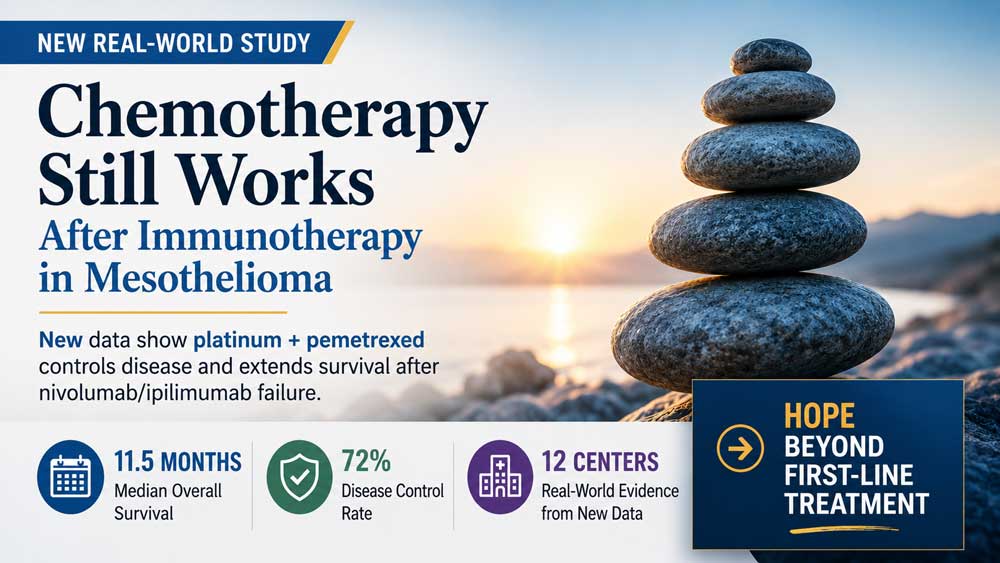
A new real-world study from Germany offers encouraging news for people living with pleural mesothelioma, a rare and aggressive cancer that affects the lining of the lungs. Researchers found that a long-established chemotherapy combination remains an effective treatment option after immunotherapy stops working, helping many patients control their disease.
The study, published in Clinical Lung Cancer, examined what happens after patients receive the immunotherapy combination nivolumab and ipilimumab as their first treatment. While this drug combination has become a standard first-line therapy for many patients, doctors have had limited evidence to guide treatment once the cancer progresses.
The new findings suggest that the chemotherapy drugs platinum and pemetrexed continue to provide meaningful benefits, even after immunotherapy has failed.
Filling an important evidence gap
Table of Contents
Pleural mesothelioma is most commonly linked to past asbestos exposure and remains one of the most challenging cancers to treat. Although advances in immunotherapy have improved outcomes for some patients, there is currently no approved standard second-line treatment after first-line immunotherapy.
To better understand what happens in everyday clinical practice, researchers analyzed data from the German MesoNet registry, which includes patients treated at 12 cancer centers across Germany. The study focused on 135 patients who had received nivolumab and ipilimumab as their initial treatment. Of these, only 57 patients, or 42%, were healthy enough to receive a second round of treatment after their cancer progressed. Among those patients, nearly three-quarters received a platinum-based chemotherapy combined with pemetrexed (also known to many patients as Alimta), making it by far the most common second-line treatment.
Chemotherapy remained effective
Researchers found that patients treated with platinum and pemetrexed (Alimta) lived a median of 11.5 months after starting second-line chemotherapy. Their cancer remained under control for a median of 5.8 months before beginning to grow again. Perhaps just as importantly, the treatment was able to stop or shrink tumors in most patients. About 28% experienced a partial reduction in tumor size, while another 47% had stable disease, meaning their cancer did not worsen during treatment. Overall, 72% achieved disease control.
These results are remarkably similar to what has historically been seen when the same chemotherapy is used as an initial treatment. This suggests that prior immunotherapy does not appear to reduce the effectiveness of platinum and pemetrexed. For oncologists, this is reassuring because it supports the current practice of using chemotherapy after immunotherapy when the disease progresses.
Not every patient reaches another treatment
One of the most striking findings was not about the effectiveness of chemotherapy but about how quickly patients can become too ill for additional treatment. More than half of the patients who started immunotherapy never went on to receive a second-line therapy. Their disease either progressed too rapidly or their overall health declined before another treatment could begin.
The numbers became even smaller with later treatments. Only 22 patients, representing just 16% of the original group, received a third line of therapy.
This pattern, known as treatment attrition, highlights the aggressive nature of pleural mesothelioma. It also emphasizes why doctors often recommend planning future treatment options early, before a patient’s condition deteriorates.
Real-world evidence
One reason this study is valuable is that it reflects what happens in routine medical practice rather than in the highly controlled environment of a clinical trial. Clinical trials typically enroll carefully selected patients who meet strict eligibility criteria, such as having few other medical conditions and good overall health. In contrast, real-world studies include the broader range of patients doctors see every day, including older adults and those with more complex health issues. While real-world studies cannot prove cause and effect as reliably as randomized clinical trials because treatments are not assigned randomly, they provide important insights into how therapies perform in everyday practice and can help guide treatment decisions when clinical trial data are limited.
Patients treated in community and academic hospitals often have a wider range of ages, health conditions, and disease characteristics than those enrolled in research trials.
Because of this, real-world studies provide valuable information about how treatments perform outside carefully controlled research settings.
Researchers also compared their findings with similar studies from the Netherlands and Japan. All three studies reported very similar results, particularly for the length of time patients lived without their cancer progressing after chemotherapy. This consistency strengthens confidence that platinum and pemetrexed remain a reliable second-line option.
Questions still remain
Although these results are encouraging, the study has important limitations.
It was a retrospective analysis, meaning researchers looked back at medical records rather than assigning treatments in a randomized clinical trial. Only 57 patients received second-line therapy, and just 43 were treated with platinum and pemetrexed, limiting the strength of some conclusions.
Researchers also explored whether factors such as tumor subtype, age, or disease stage influenced outcomes. However, these analyses involved small numbers of patients and were considered exploratory, meaning they should not be interpreted as definitive.
Future prospective studies will be needed to determine the best sequence of treatments and to identify which patients benefit most from chemotherapy after immunotherapy.
Several clinical trials are already underway to evaluate new therapies for patients whose disease progresses after immune checkpoint inhibitors.
Take-home message for patients and clinicians
While immunotherapy has transformed the treatment landscape for pleural mesothelioma, this study shows that chemotherapy still has an important place in patient care.
Rather than becoming ineffective after immunotherapy, the combination of platinum and pemetrexed continued to provide meaningful disease control for many patients, with survival outcomes comparable to those seen in earlier treatment settings.
The findings also reinforce another important lesson: because mesothelioma can progress rapidly, timely evaluation for additional treatment is essential. Patients who remain well enough to receive subsequent therapies may have more opportunities to benefit from advances in treatment.
Although more research is needed, this real-world study provides reassuring evidence that a well-established chemotherapy regimen continues to offer meaningful benefits after first-line immunotherapy, helping to fill an important gap in the management of this difficult disease.

Related Posts

Belluck Law Wins Motions in Mesothelioma Case Involving Asbestos Exposure from Talcum Powder and Cosmetic Products
September 24, 2026
What the Newly Published 2026 NCCN Guidelines Mean for Mesothelioma Patients
September 11, 2026